
Hope Heals Camp: How Love Disrupts the Hierarchy
Helping can put us above one another. Love pulls us into mutuality and presence. {Plus 2 fun things, 4 things worth your time, and 1 thing I'm pondering}

You may have noticed that I didn’t write a Substack last week. I took the week off because I was at Hope Heals Camp in Nauvoo, Alabama, with our family. And now I have too many thoughts to share with you, so you may be reading about camp for weeks to come!
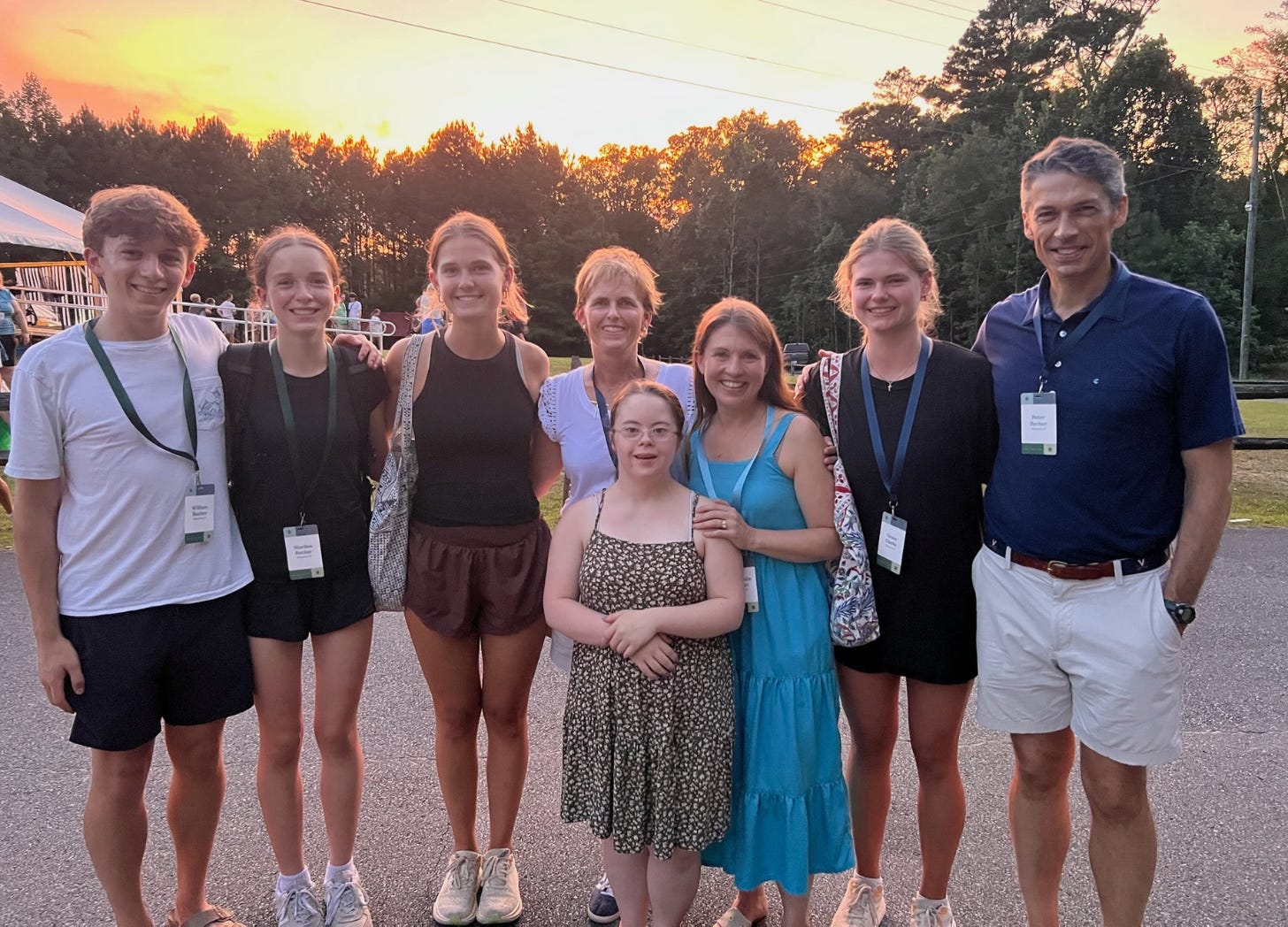
For those of you who aren’t already familiar with it, Hope Heals Camp happens every summer at Camp McDowell in northern Alabama. Families affected by disability gather—for free—for a week of exceptionally gracious welcomes, fun programming, and beautiful connection. Each week hosts about 300 campers alongside 250 staff and volunteers (who pay tuition to attend in this very upside-down way). Together, it becomes a glimpse of what the world could be if we believed our belovedness, received that belovedness from the source of all love, and lived into that love with one another. (If you’re wondering if this camp might be for you, here’s what Penny wrote last year about why you should go!)
One of my roles this past week was called “Disability Educator.” Penny and I shared this responsibility, which was a joy in and of itself as we got to tell the camp our story of disability together and she helped me lead a retreat on Reimagining Family Life with Disability, as well as a workshop on Taking the Next Step toward a Good Future.
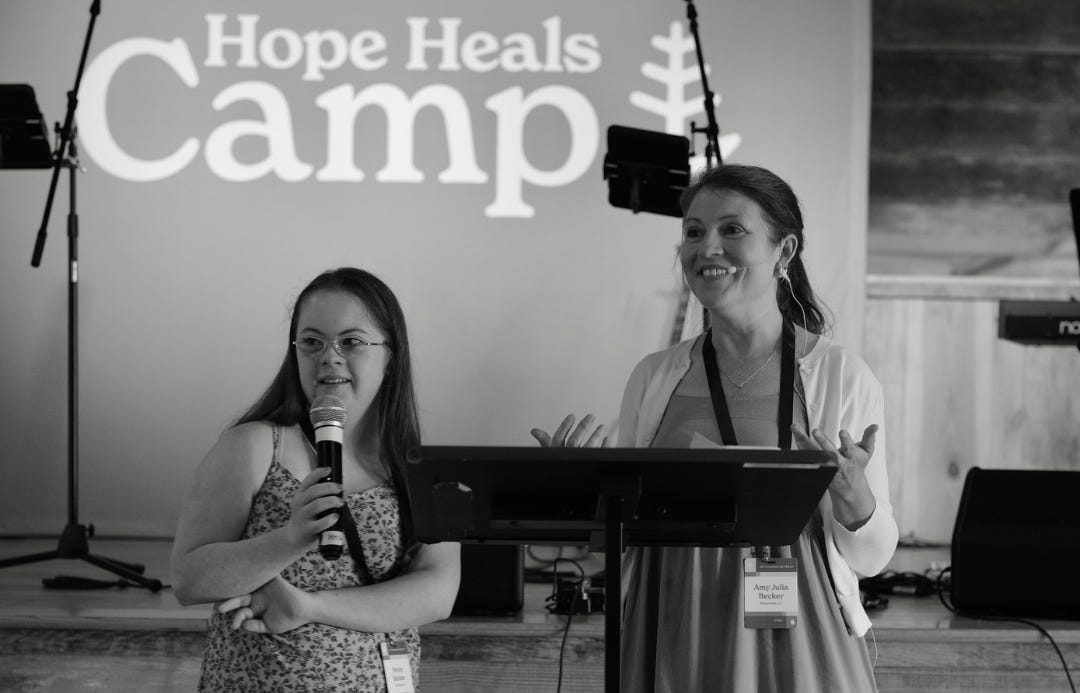
I also had a chance to meet one-on-one with various parents who wanted to talk through those next steps. One of those parents reflected on the attitude her typically-developing daughter has towards her disabled sister. “She (the typical daughter) wants to help her (the daughter with a disability), but I’m not sure she wants to love her.”
The Distinction Between Help and Love
That sentence summarized so much of what I experienced at camp last week—that distinction between help and love. Help is not bad, and we all need help at many points along the way. But if I understand myself as a helper—if my identity gets wrapped up in helping, and if all I know to do is help without admitting my own neediness—well, then I set up a social hierarchy where I’m on top. I distance myself from those in need. But if I enter into a relationship of love with someone, then I’m breaking down a social hierarchy. I’m helping when they need help. I’m also allowing my own neediness to become evident. Mutual giving and receiving ensues.
At camp last week, we didn’t hear an explanation of this kind of love. We experienced it.

I saw campers with intellectual disabilities bless and befriend their compassionate companions. I heard parents talk about how they haven’t seen their disabled children so at peace, so confident, so comfortable, ever before. I received my own deepened understanding of belovedness. I wasn’t teaching at camp this year, and I wondered whether I wasn’t using my gifts. I had a sense that instead of maximizing my potential, God was interested in patiently helping me understand that I am loved for who I am and not what I produce.
The Only Answer We Have
One afternoon, Marilee and I were walking together. Earlier that day, we had both learned a hard story about a camper who had been abused. She said, “You know, Mom, that’s the kind of thing that makes me wonder whether God is real and whether God is loving.”
I said, “That’s exactly the question we should be asking when we know that a totally innocent and vulnerable child has suffered trauma for absolutely no reason. I could give you the technical theological answer to the question, but that answer isn’t satisfying at all.”
The only answer we had at camp was love. Suffering cannot be explained, but it can be alleviated when we enter into it together. Pain cannot be erased, but it can begin to heal when we hold our stories alongside one another.
Hope Heals does not deny the reality of suffering, sorrow, or fear. But it wraps those realities in love. In much of our world, the opposite is true. We wrap our love with fear and sorrow. We constrain our love—make sure it doesn't get too big and overwhelming and out-of-control. And then the fear and sadness grows, and the love struggles to remain.
But love is big enough to contain hardship, make space for lament, and grieve the loss of lives gone far too soon. And when love wraps around our pain, the love can grow. The pain can heal.
I can’t fully express how grateful I am that our family gets to experience a place of love, hope, and joy like this every summer.
-Amy Julia
P.S. Keep scrolling for 2 fun things, 4 things worth your time, plus what I’m pondering these days.
2 Fun Things
Ninja Creami
I have to tell you about our new Ninja Creami. It lives up to the hype. We got ours after enjoying gelato every single day in Italy, and we wanted to try to continue that trend. So far, banana, mango, and protein vanilla are our favorite flavors.
New Favorite Table Question
I have a new favorite table question. (Last summer’s favorite was “If you had to create a 30-minute presentation on a topic not related to your work, what would it be?”) This one is:
“If your life right now was a picture of a landscape (or seascape), what would it be?”
Our family answered that one with: the hills of Tuscany, a forest, a summer beach cottage, the High-line in New York City, and a path through the foothills with mountains up ahead. I’ll let you guess who said what for that one!
4 Things Worth Your Time
BOOK: The Hospitality of Need by Kevan Chandler and Tommy Shelton
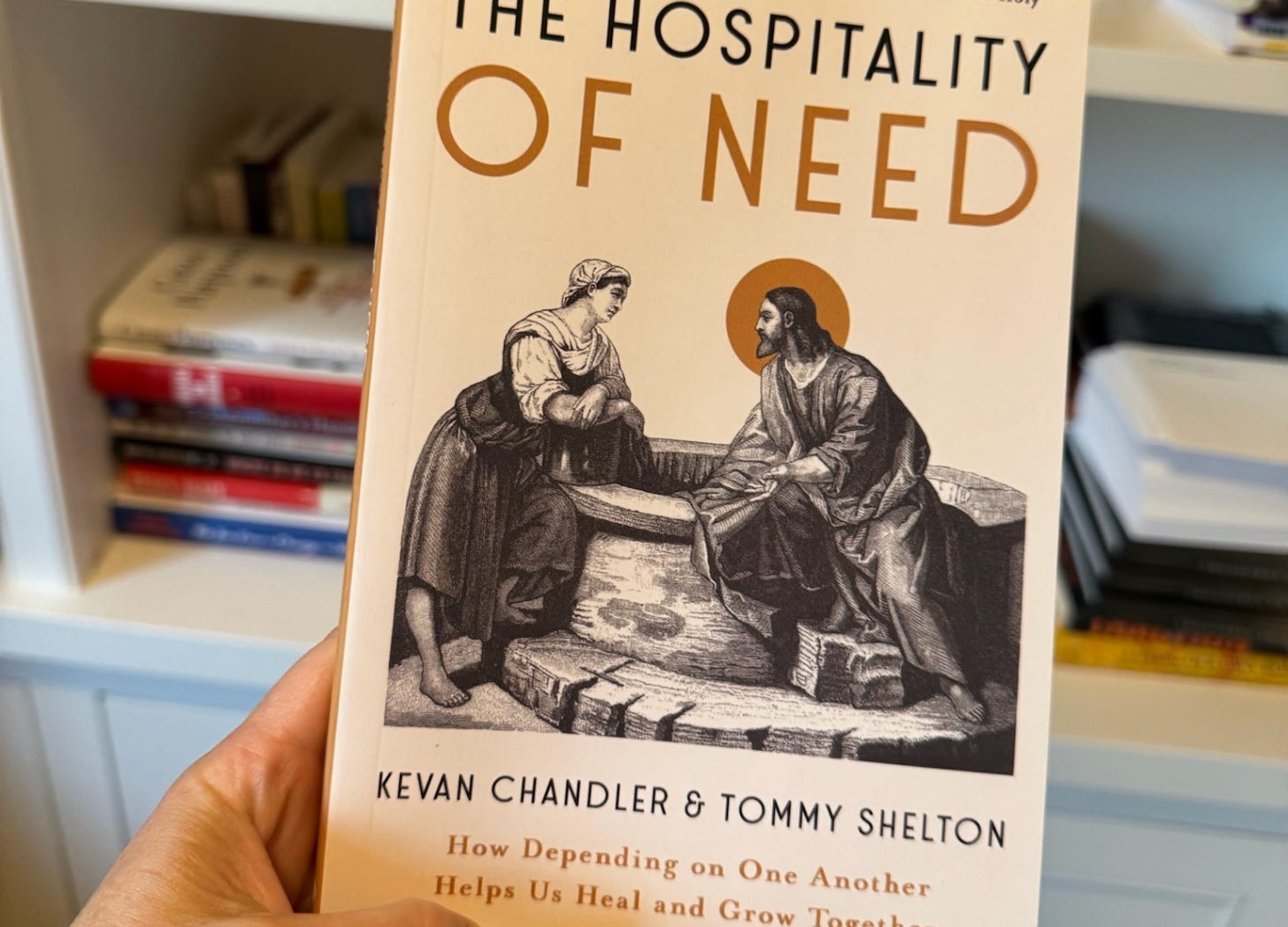
This book was the perfect companion for my time at Hope Heals. Kevan Chandler lives with spinal muscular atrophy, so he uses a wheelchair to navigate the world. He tells the story of admitting his own need and recognizing how that need can serve as a way to welcome others in need. Kevan’s friends have cared for him in ways most of us fail to imagine. They arrange their schedules to help him use the toilet, bathe, eat, and travel (including a two-week trip to Europe without his wheelchair).
Kevan reflects beautifully on the universality of need as well as the universality of being ones who are needed. He writes:
“Needs shake us, whether they belong to us or to someone else. If we’re in proximity, they can change us. They can cause us—force us—to slow down or keep up, to think and act differently from our norm. They can pull us out of our comfort zones and disrupt the ideal rhythms by which we usually function. They can either set right the broken or break the too-perfect.”
RESOURCE: DIGNITY TRAILER
I love seeing organizations use their imaginations to create a world of welcome and belonging. Watch this short video from Certain Hope Community in Michigan about the dignity trailer. Designed exclusively for families experiencing disability, “this fully accessible mobile restroom is equipped with features built upon the beacon of inclusivity and compassion.”
PODCAST EPISODE: Xavier Le Pichon — The Fragility at the Heart of Humanity
This conversation (from a while ago) was so fascinating and encouraging. Le Pichon is both a geophysicist working on plate tectonics and a practicing Catholic living among people with intellectual disabilities. He contrasts “systems that incorporate fragility and evolve” with those that “reject fragility and become rigid,” like the tectonic plates that cause earthquakes. And he says:
“When you put the weakest at the center of the community, they become the ones who are going to regulate the life of the community.”
Thank you to Andrea Bobotis for this recommendation—it is a lovely conversation about why we need one another and how honoring our common fragility makes us human.
TEDx | I’m not your inspiration, thank you very much | Stella Young
As I work on my next book, I’m returning to some resources from a while ago, including this Tedx talk by Stella Young. Young explains the idea of “inspiration porn,” images that objectify disabled people for the benefit of nondisabled people. As she says, “Disability is not a bad thing. And it doesn’t make you exceptional.” She says she envisions a world in which disability is not the exception, but the norm.
1 Thing I’m Pondering
Super Babies and the Cost of Control
I recently read a Washington Post essay entitled “Inside the Silicon-Valley Push to Breed Super Babies.” It describes the latest technology to screen embryos for genetic differences, technology which claims to be able to use 5 embryonic cells to sequence the 3 billion base pairs of an embryonic genome. Apparently there are problems with the company’s scientific claims. But even more, the desire to “eradicate suffering” and champion parents who “choose their embryos by spreadsheet” and create “a generation that gets to be genetically blessed and avoid disease”—all plays into a false narrative about who we are meant to be as humans.
First of all, eradicating human lives is not an effective way to eradicate suffering. Second, as I wrote in my note above, the way to address suffering is not to eradicate it but to enter into it with love. And third, we lose our humanity when we construct life according to our predictions rather than receiving it as it is given, in all its precarity and beauty.
I just spent a week with dozens of individuals who would have been named as genetic misfits. A young girl with Down syndrome looked me in the eye, anointed me with oil and said, “I am with you. I am for you. God is with you. God is for you. And I love you.” A young man who uses a wheelchair to navigate and adaptive technology to speak proclaimed to all of us that his life is good.
It is scary to receive life as it is given. And yet that posture of loving receptivity opens us up to the fullness of who we are, not as autonomous individuals but as diverse, confounding, interdependent creatures.
What are you reading, watching, or listening to these days?
🎙Listen to the podcast Apple | Spotify | YouTube | More
📰 Miss a week? Read past newsletters here.
📧 Questions or feedback? Leave a comment. I read every comment and email reply from you!
As an Amazon Associate, I earn from qualifying purchases. So, if you use a link from here to purchase something I recommend, it sometimes earns me a small commission, which enables me to continue the work I do here. Thank you!
"A young man who uses a wheelchair to navigate and adaptive technology to speak proclaimed to all of us that his life is good." I love this. I believe this.
Ginny Owens, my niece, loves participating in Hope Heals Camp. We got to spend time with her for a few hours when it was over.