
Why I Am Pro-Aging
Celebrating wrinkles, gray hairs, and life {Plus two links worth your time}
On Thursday, I will turn 49 years old. Happy birthday to me!
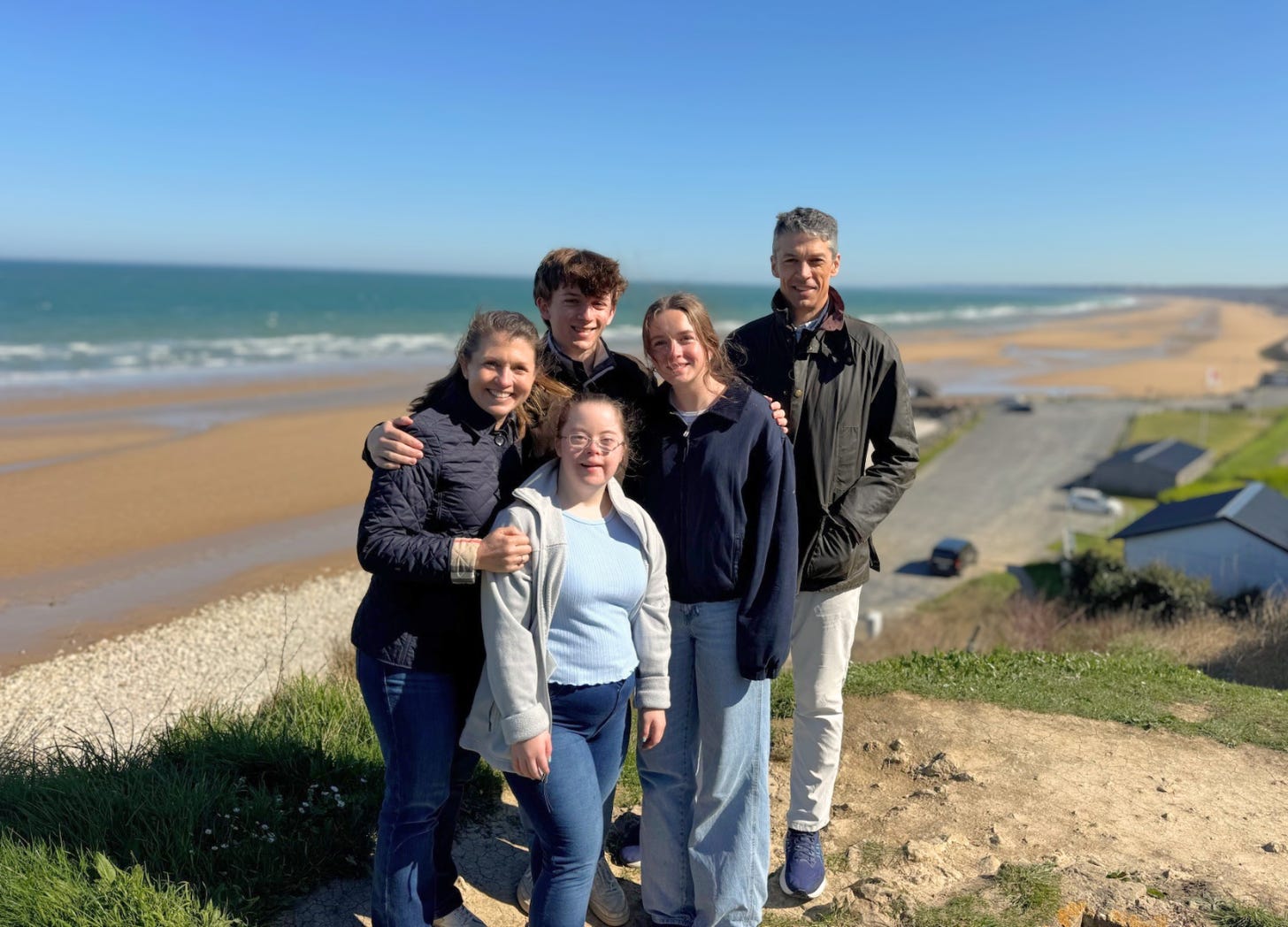
It’s been a year of feeling my age. I notice the sun spots on my face and arms. I wonder how long it will take before the deep wrinkle that emerges between my eyes when I’m thinking becomes permanently etched into my face. I’ve started to see gray hairs. I’ve gone up a pants size.
Amidst all those subtle but real changes, I’ve also thought about all the ways I could resist these physical signs of age. I could avail myself of Botox and hair dye. I could change my diet, try a GLP-1 drug, or hire a personal trainer. I could experiment with all the “anti-aging” products Instagram offers me daily.
Instead, I’ve realized that I am “pro-aging.”
I don’t mean that I love the crow’s feet or the fact that I might never wear a short skirt again. And I certainly don’t mean that other people shouldn’t avail themselves of beauty products or fitness programs. I wear makeup and buy new clothes and workout regularly, and each of us will make different decisions about the line between caring for our bodies and obsessing over them. But I do want to champion growing older and letting my age show. I want getting older to be a gift, to myself and to those around me.
One of the most challenging aspects of living within the disability community has been learning to receive other humans as they are, and learning to celebrate both their limitations and their gifts. Rather than trying to fix other people, disability has been an invitation to love other people. And perhaps more importantly, disability has been an invitation to love myself, as I am, wrinkles and belly rolls and gray hairs and all. It’s also an invitation to believe that my appearance is not all that I am, but also that it says something good about who I am. That beneath those lines on my face lie the stories of laughter and tears, and beneath the padding on my body rest so many moments of celebration and conversation around tables filled with beloved people. So on a personal level, accepting myself as an aging human is a way for me to recognize the goodness of the days behind me and walk with gratitude into the good days ahead.
But the other reason I’m pro-aging has to do with wisdom. In an era marked by “artificial intelligence,” I want to cultivate the kind of knowledge that only comes from living a real life, experiencing real regret, loving and listening and learning from other humans. I want to cultivate intergenerational communities, where I am looking up to those older than me and pouring into those who are younger. I think about the wisdom Arthur Brooks identifies in his book From Strength to Strength, the wisdom that only comes after years upon years of learning. I want to cultivate that type of wisdom, receive it from others, and pass it along.
So for all my fellow middle-aged humans out there, here’s to growing up and growing older. May we steward these lives—body, mind, and spirit—in a way that honors who we are becoming. May we offer kindness and gentleness and patience to ourselves and others through all the mistakes we’ve made and all the ways we’ve learned what is good.
Blessings,
Amy Julia
P.S. Keep reading for a research opportunity, one fun thing, and two links that are worth your time.
Take the Next Step podcast:
Disability + Family: What Is Good? What Is Hard? with Renee Dollenmayer

E20—Does your child struggle to understand who they are in a world that sees disability as a deficit? Renee Dollenmayer is a speaker, coach, and founder of Even If Ministries. She was diagnosed with cerebral palsy at the age of two and has experienced the joy and sorrow of disability. Learn how she has navigated those emotions, discovered a sense of calling and purpose, and why she cares so much that people with disabilities know how much their presence matters.
“The biggest lie is believing that they don't have a purpose or believing that they are a burden to society.”
“Community has been one of the greatest blessings and also the greatest struggle because letting people into your pain and weakness, when the world views pain and weakness as something to run from, is very scary, especially as a young adult in a culture that is very self-sufficient. When you come with your brokenness and your needs, it’s still one of the most terrifying things I’ve ever had to do, but it’s also the most beautiful…”
Parenting, Patience, & Disability Study
My good friend, Professor Erik Carter, shared an opportunity for parents to participate in a research study through Baylor University:
For parents of children with disabilities—You are invited to participate in a first-of-its-kind research study exploring how parents experience and understand patience while raising children with developmental disabilities. Your insights will help us develop practical resources to support parents and caregivers as their children transition toward adulthood. To learn more and sign up, go here.
1 Fun Thing
We got to gather a lovely group of about 20 people at our home on Saturday night, and we used the Hope Heals conversation cards as a little nudge towards more connection and conversation. We asked for 3-4 volunteers, and each of them received a stack of cards and got to select a question they wanted to answer. Then, when they read their question and answered, anyone else in the group who wanted to share their answer could too. It was a simple way to learn a little bit about one another (who knew how passionate people could be about roller-coasters!) without making anyone feel uncomfortable because they had to answer a question on the spot. I’ll be pulling them out again for our Easter meal!
Upcoming Event
Journey of a Joyful Life and Journey School • Keynote | Texas • 4.16.26

Free Resource: Reimagining Identity
A helpful tool for students, parents, youth group leaders, teachers, and more!
Many high school seniors received their college decision letters last week. It's easy for us to construct an identity for ourselves and our kids through abilities. Discover a new way to think about identity—one grounded not in ability or appearance, but in belovedness and belonging. Download this free visual guide and begin reimagining identity in a way that moves you toward compassion, celebration, and community.
2 Links Worth Your Time
Novel: All the Light We Cannot See by Anthony Doerr
As readers of this newsletter know, we just spent a week in France as a family. We traveled to Saint-Malo, the site of All the Light We Cannot See. It inspired me to go back and reread this story of two teenagers—one in occupied France during WWII, the other an orphan in Germany who ends up as a soldier. It’s a beautiful, harrowing story of love and resilience and beauty. It has sold millions of copies worldwide. I noticed this time more than the last time I read it that characters with disabilities—whether that’s blindness or mental illness or intellectual disability—are portrayed as very full humans with great purpose and significance. The book as a whole is opposed to the Nazi regime, but there’s a more subtle story within it. When we value vulnerable humans, we value our full humanity rather than reducing each of us and all of us to utility.

Film: On the Basis of Sex
I also watched this 2018 film on our flight to France, which is the story of former Supreme Court Justice Ruth Bader Ginsburg’s early career. It’s good—if infuriating—to remember how our society was structured to keep women out of high-level careers and how much it took to break through those barriers. Such a well-done movie, with good reminders from history and also relevance to our current moment.
What are you reading, watching, or listening to these days?
If you know someone rethinking the “good life” and longing for a world where every person is loved, belongs, and matters, please forward this email to them.
🎙Listen to the podcasts.
📰 Miss a week? Read past newsletters here.
As an Amazon Associate, I earn from qualifying purchases.
Fantastic! Thank you!
Beautiful.